
2007 Chevrolet Silverado 2500 Duramax: DPF Overloaded, Not Failed — Proven With Live Data
Two DPF codes and a restricted filter usually mean one quote: replace it. Live data told a different story — this DPF was overloaded with soot, not damaged, and a verified regeneration brought it back.
October 2026 · Las Vegas, NV
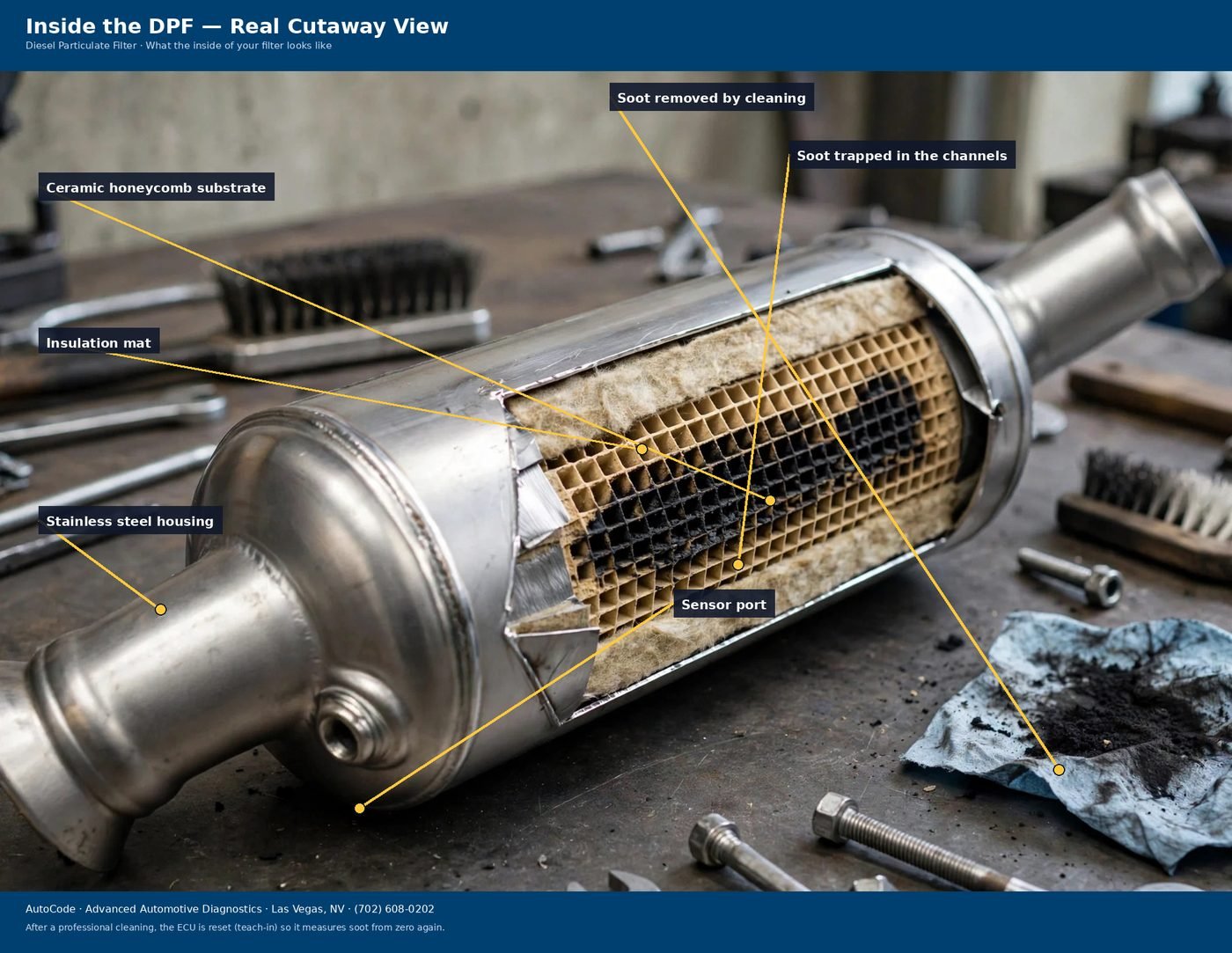
This 2007 Chevrolet Silverado 2500 with the 6.6L Duramax LMM diesel came to AutoCode in Las Vegas with a restricted diesel particulate filter (DPF) and two fault codes: P244B (DPF differential pressure too high) and P2463 (DPF soot accumulation). A clogged-filter code is where many owners get sold a new DPF — one of the most expensive parts on a diesel truck.
Before quoting anything, AutoCode verified the restriction with live data and checked whether the pressure sensor itself could be trusted.
What We Found
The numbers confirmed a real restriction, not a lying sensor: soot mass read 90 g, and DPF differential pressure sat at 21–22 kPa at idle — far above what a healthy filter shows. Crucially, with the engine off, the same sensor returned to about 0 kPa. A sensor that zeroes correctly is telling the truth: the filter really was packed with soot.
That distinction decided the whole job. A failed DPF needs replacement; an overloaded DPF needs its soot burned off and the result verified.
- Codes P244B (differential pressure too high) and P2463 (soot accumulation)
- Soot mass: 90 g on live data
- Differential pressure at idle: 21–22 kPa — a genuine restriction
- Sensor returned to ~0 kPa with the engine off — sensor reading honestly
The Result
AutoCode performed a service regeneration and then verified the outcome on live data instead of just clearing codes: soot mass dropped from 90 g to 3.97 g, and idle differential pressure fell from 21–22 kPa to −0.4 kPa. The filter was flowing again.
Verdict delivered to the owner: the DPF itself is good — it was overloaded, not failed — so no DPF replacement was sold. One honest note, given to the owner and repeated here: if soot ever builds up abnormally fast again, the next step is to check the engine side (injectors, boost, EGR) and the truck's driving pattern, because a healthy engine should not load a filter that quickly.
- Soot mass after regeneration: 3.97 g (was 90 g)
- Idle differential pressure after regeneration: −0.4 kPa (was 21–22 kPa)
- DPF kept in service — no replacement sold
The Lesson
DPF codes do not automatically mean a dead filter. Measure the soot load, prove the sensor is honest (it must read ~0 with the engine off), regenerate, and verify the numbers afterwards — that is how you know whether a truck needs a service or a very expensive part.
Having the same problem with your vehicle?
AutoCode brings dealer-level diagnostics, programming and electrical repair to you — mobile service across Las Vegas, Henderson, North Las Vegas and Summerlin, and shop service by appointment.